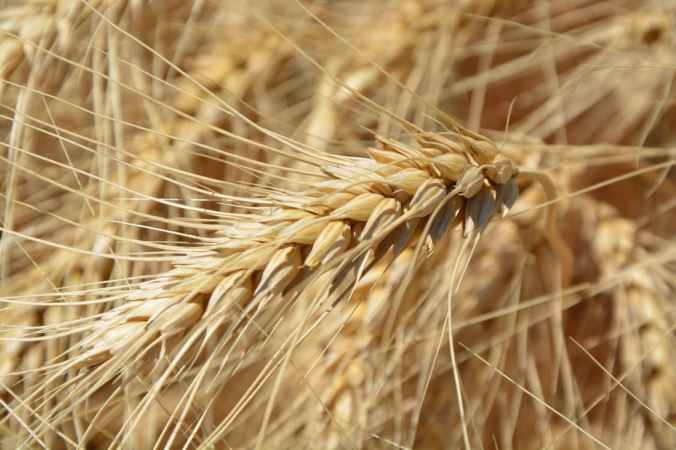
Have you ever thought about Jesus’ statement about the fields being “white unto harvest?” Why not golden or brown? My first impression of Ethiopia as we were leaving the capitol was that as far as the eye could see the fields were white unto harvest. White, in this case, is a relative term. Of course they weren’t snow white. When wheat, barley, and yes, teff mature they begin to translocate nutrients from the leaves and stems into the seeds (their fruit).When this process is complete the plant is dead and it has a bleached appearance — “white”. As it dries further it will turn golden from the sunshine. Further ripening, drying, and weathering will turn it brown then gray or worse.
When we visited the remote village we realized we were interfering with the harvest by inviting people out of the fields for services. Not a big deal I thought. The rainy season is over and the chance of significant weather damage is over. It’s too dry for green weeds to interfere with harvest. What’s the rush? It didn’t dawn on me until we got home why there was so much urgency. We harvest with combines and we wait until the wheat dries to at least golden in color. Brown is even OK. In the world of combine harvesters, we want the grain (cereal grains) to be dry enough to store when we harvest. If we can get the grain into the header without shattering, it is captive unless something is out of adjustment and we lose some out the back. Hot dry weather is our friend for a speedy harvest.
Hand harvesting in Ethiopia is obviously much different. First, the wheat is cut one armful at a time. A sheaf is formed by twisting a handful of stalks around the bundle to hold it together. Sheaves are stacked together in shocks or piles until they are ready to be moved to the threshing floor. The sheaves endure a donkey ride and then are stacked around the threshing floor. The biggest loss in harvesting is the seed shattering to the ground when the crop is completely dry. How can this be avoided? Start harvesting when the grain is white! All the nutrients are already in the seed, it just needs to be a little drier for storage. At the white stage wheat can be cut with a sickle and bundled into sheaves without shattering. The wheat will continue to dry as it stands in shocks and when it is piled by the threshing floor. If it is fully dry when threshing begins, grain will be separated from the rest of the plant by flail or trampling by oxen. You know the rest — the straw is forked away, and the grain is winnowed (or cleaned) by tossing it up and allowing the wind to drive the chaff away. If harvest had been delayed until the grain was fully dry in the field, major losses would have occurred. Dry grain could have shattered as the sickle cut through the stalks. More could have been lost when tying the sheaves. Piling, transporting, and re-piling could also cause losses. Note — teff is extremely brittle and shatter-prone when completely dry.
OK, what is the spiritual application here? When we were in Ethiopia we saw throngs of people in the capitol before we saw the crops in the field, so it was very easy to make the connection to a spiritual harvest. But “white” — how does that apply? The harvest must be in progress now!! It is more urgent than we thought! If we delay, there will be losses. Souls that were reachable may have fallen out of sight or out of reach. Small windows of opportunity may be closing. We may be near the end of the age (“night is coming when no man can work”).
As we were leaving Addis I told Leul “behold, the fields are white unto harvest.” He answered, “Pray that the Lord will send workers to His harvest.”
 Bright Canaan