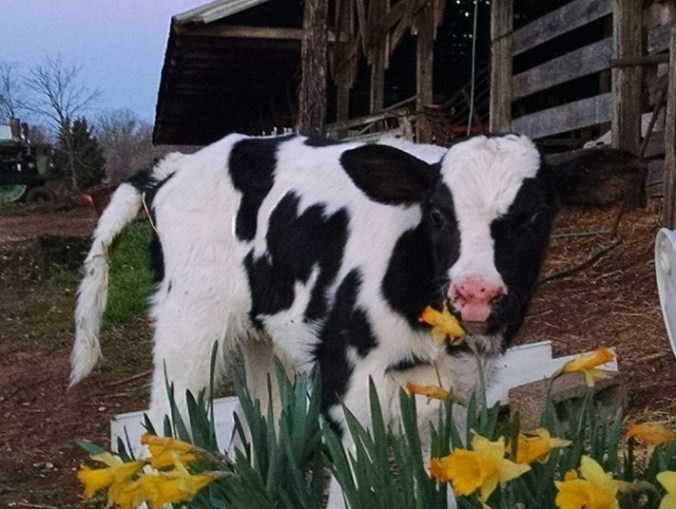
All around us new life is bursting out! Grass is growing, providing a verdant carpet for fields that have just recently been dormant from the effects of frost and cold. Daffodils, crocuses, and other perennials add their glory to the season. Maple trees are taking on a reddish hue as their buds swell. (I am writing this in early March.) Some flowering trees are already blooming. By the end of March, leaves will begin pushing from the swollen buds. The quiet nights have given way to a chorus of frogs who take the stage when the birdsongs fade out at evening. Soon both the frogs and birds will be laying eggs that will bring forth a new generation of their species, as they have ever since creation. Soon the soil will be warm enough to sprout seeds, and new plants will emerge to face whatever challenges that may confront them as they glorify their Creator!
We, in the Northern Hemisphere, are blessed that springtime occurs at Easter time. I can’t imagine having Easter in the fall. All the excitement of springtime helps to give meaning and credibility to the resurrection of Christ, and the possibility our own eventual resurrection as well. In John 12:24, Jesus was referring to His pending death and resurrection when He said, “…unless a grain of wheat falls into the ground, and dies it remains alone; but if it dies, it produces much grain.” In the next verse, He ties this analogy to the believer who becomes dead to the world but becomes alive for eternal life. Paul gives a similar illustration in 1 Cor. 15:36, “what you sow is not made alive unless it dies.”
We don’t know if Paul had heard of Jesus’ statement, but they were both very accurate in the choice of seed used in their analogies. They both used a grain of wheat. Not just any seed would have fit the illustration. It had to be from those species classified as monocotyledonous or as having a single seed leaf. Most grasses, including the cereal grains, fall into this category. When a monocot is dropped into the ground, it has the potential to sprout if it is viable. Sprouting will only occur if both moisture and temperature are favorable. Moisture will penetrate the pericarp (outer seed coating) and be absorbed by the endosperm (the starchy portion), causing it to swell and become available to the tiny epicotyl (germ or living part). The epicotyl draws nutrients from the endosperm as it extends a root downward into the soil and pushes the growing leaf upward toward the soil surface and sunlight. If you plant a grain upside down or sideways, no problem, the root will loop downward and the leaf upward. By the time we see a green leaf above the soil surface, there is also a functioning root underground. The green leaf is capable of processing nutrients and moisture from the roots, and provides the nutrition for the growing plant through photosynthesis. The young plant is now on its own. The old seed has spent all its nutrients, is now dead, and will decay.
Dicotyledons don’t fit this illustration very well. We’ll take a bean for example. The bean seed has two halves (cotyledons). When soil moisture and temperature are favorable, germination can begin. The seeds swells and bursts the pericarp. A root begins to extend down, but the whole seed is pushed up out of the ground! Although the epicotyl has drawn nutrition from the cotyledons, they are not totally consumed. They turn green in the presence of sunlight, and actually become the first two leaves. This doesn’t make dicots less holy than monocots, it just makes them not suitable for Jesus’ lesson. Obviously Jesus was aware of all this when He chose which seed to use in His explanation of death and resurrection.
As we enjoy this spring season, let’s reflect much about the new life that is all around us. As we contemplate Easter, let’s visualize Jesus’ death and burial, realizing that it was necessary in order for Him to be resurrected and bear incredible eternal fruit! By His resurrection, a new era in the relationship between God and man was instituted. We are dead to sin but alive with new life in Christ (Romans 6: 1-13). We are dead to the law and alive with new life in the Spirit (Romans 7:1-6).
New life, fresh unblemished new leaves, exuberant birds and frogs; each is glorifying the Creator! How can we adequately glorify God for the new life that He has made possible for us through Jesus’ death and His triumphant resurrection?
 Bright Canaan