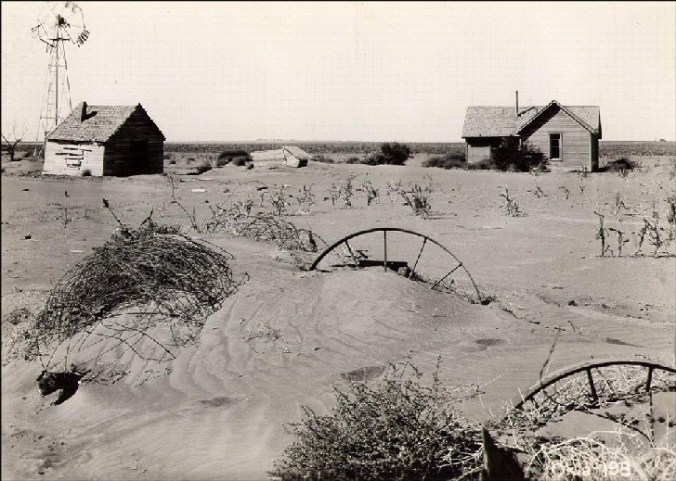
In Virginia we don’t think about wind erosion as being a significant problem. It is much more common in dryer climates where there is less moisture holding soil particles together, and the wind is stronger and more persistent. In the US, those conditions are most widespread in the Great Plains region from Texas to the Dakotas. It was in this region that the phenomenon we call the “Dust Bowl” occurred from 1930 to 1939. This event has been called by some the greatest environmental disaster in modern history. It was so disastrous that it brought people in high places to the realization that our nation was on the verge of soil bankruptcy. According to one estimate, enough soil was moved during this period to fill the Grand Canyon! Soil scientists had been aware that back in the East, equally damaging but much less dramatic, soil erosion had been going on for over 300 years. In both scenarios farmland had been abandoned because families couldn’t survive economically on it. It took the Dust Bowl to raise the alarm loud enough to give impetus to change. The Soil Conservation Service was formed, and it addressed soil conservation needs all across the US.
The conditions leading up to the Dust Bowl took a lot of years to converge into one dramatic event. In 1862 the Homestead Act was passed by the US Congress. Earlier attempts had failed in fear of slaveholders taking huge tracts of land. Any citizen could claim 160 acres to farm by paying a small filing fee, making a few minimal improvements, and living on the land for 5 years. In 1873 an additional 160 acres could be applied for if 40 acres were planted in trees. The best land was taken first, usually lower-lying land along streams and rivers. In 1904 the homestead acreage was raised to 640 acres on some of the less desirable land west of the 100th meridian. In 1916 a stock-raising provision also allowed an additional 640 acres.
All of this encouraged a great influx of settlers into the region. The new landowners farmed the way they knew how. Tillage was used for both seedbed preparation and weed control. Soil conservation was unheard of. Crop yields were good, even by today’s standards, when there was adequate rainfall. Tillage of virgin lands, though destructive to soil organic matter, made nutrients available to crops. The 10 years prior to the Dust Bowl era were ironically above average in rainfall, thus encouraging an increasing number of tilled acres. When the drought of the 1930s came, the number of acres of exposed soil was at its peak.
The prolonged drought brought along with it devastating wind storms. The Dust Bowl’s footprint was 100,000,000 acres. The Yearbook of Agriculture 1934 (Remember this event lasted until 1939) reported that 35 million acres had already been destroyed for crop and livestock production. Another 100 million acres had lost all their topsoil, and 125 million additional acres were losing topsoil at a rapid rate. There were several notable storms that were especially devastating. One occurred on May 9&10, 1934. It was 1500 miles long and 900 miles wide. It transported an estimated 650 million tons of topsoil. The city of Chicago received 12 million pounds of soil in that single event. April 14, 1935, was known as Black Sunday. Dust was visible on the eastern seaboard as much as 2000 miles from the source. Visibility at ground zero was as low as 5 feet. Over 300 million tons of soil were transported in this event. Needless to say, the effect on man and beast in the Dust Bowl region was horrific. People suffered many health problems and were ruined financially. Many animals died. Those surviving suffered respiratory problems as well as poor nutrition due to the decline in feed production. Many families had to exit from the region. Three million people joined the ranks of the already burdensome unemployed population. The Great Depression, unfortunately, occurred simultaneously with the Dust Bowl. Creditors foreclosed on nearly a million farms in the Dust Bowl region.The most productive soil was gone. Nutrients and organic matter that had accumulated in the upper layer of topsoil for thousands of years were gone. North Dakota alone lost an estimated 16 billion tons of topsoil. The remaining soil was much lower in organic matter and nutrients than the soil that had been lost.
The Dust Bowl era was not the most severe drought on record for the affected region. There was a more prolonged drought in the latter 1800’s. The real killer in the Dust Bowl was the huge acreage of exposed soil when compared to other droughts. There was a prolonged drought in the same region in the 1950’s, but due to less exposed soil, there was only a fraction of the devastation of the Dust Bowl era. If there was a ”silver lining”in this catastrophic event, it was that it brought America to the realization that we were precariously close to food insecurity. We could not continue ignoring the depletion of our soil resources.
In 1933 Congress formed the Soil Erosion Service and Hugh Bennet, an ardent proponent of soil conservation, was appointed its Chief. This new agency set about to bring public awareness of the need to protect soils and began setting up demonstration projects. This effort was upstaged by the huge dust storms of 1935. The literal dust cloud over Washington D.C. brought about a heightened sense of urgency in Congress. Hugh Bennet was just finishing an address to Congress on the urgency of the situation when the sky outside the capitol building became dark from a western dust storm! The Soil Conservation Service was formed with much broader focus and resources than its predecessor. Hugh Bennet was again placed in charge, and he was a dynamic leader in the conservation effort. The SCS was national in scope and dealt with both wind and water erosion. It focused on best management practices to combat erosion and hired and trained technicians to manage programs and educate landowners on a local basis. The SCS has more recently morphed into the NRCS but it still focuses on maintaining or improving soil and water quality. Go to the NRCS website for information about its history and programs. The mega dust storms and the rampant soil erosion of earlier times are no longer a threat to our food security, largely due to the effectiveness of these programs. Soil loss is still not as low as it should be in many areas and under some cropping systems, but sustainable soil management is achievable in modern American agriculture.
 Bright Canaan